Google Business Profile optimization in San Diego is no longer just about ranking on Google Maps; in 2026, it is the only way to survive the shift to AI-powered search. The landscape of local marketing has completely changed. If you own a small business in San Diego, you have likely noticed that traditional SEO strategies are yielding diminishing returns. The reason is simple: consumers are changing how they search, and search engines are changing how they deliver results.
In this comprehensive guide, we will break down exactly why Google Business Profile (GBP) optimization is your most critical asset in 2026, how AI search engines are fundamentally altering local visibility, and the exact steps you must take to ensure your San Diego business continues to thrive.
Why Traditional Local SEO is Failing in 2026
For years, the playbook for local SEO was straightforward: build a website, stuff it with keywords, acquire some backlinks, and claim your Google listing. That playbook is now obsolete. The introduction of AI Overviews in Google, alongside the rise of platforms like ChatGPT, Gemini, and Perplexity, has created a new paradigm called Generative Engine Optimization (GEO).
The Rise of AI Search Assistants
According to a recent industry report by Search Engine Land, AI assistants recommend only 1% to 11% of local businesses, revealing a massive gap between traditional Google rankings and AI visibility. Most brands that perform exceptionally well in traditional local search fail to appear in results generated by ChatGPT or Perplexity.
Why does this happen? Because AI systems do not just look at keywords; they look at entities, sentiment, and data consistency. They filter aggressively and favor locations with perfectly accurate data, strong positive sentiment, and clear differentiation. In other words, AI treats your Google Business Profile as the absolute source of truth.
The Shift from Optimization to Qualification
In the past, a business with average reviews could still rank in the Google Local 3-Pack based purely on geographic proximity and category relevance. In 2026, AI-driven results exclude these businesses entirely. AI systems prioritize confidence and risk reduction over breadth. If your Google Business Profile is incomplete, has inconsistent NAP data, or suffers from mediocre reviews, AI search engines will simply not recommend you.
The 5 Pillars of Google Business Profile Optimization in San Diego
To dominate both traditional Google Maps and the new AI search landscape, your Google Business Profile must be flawlessly optimized. Here are the five pillars you must master.
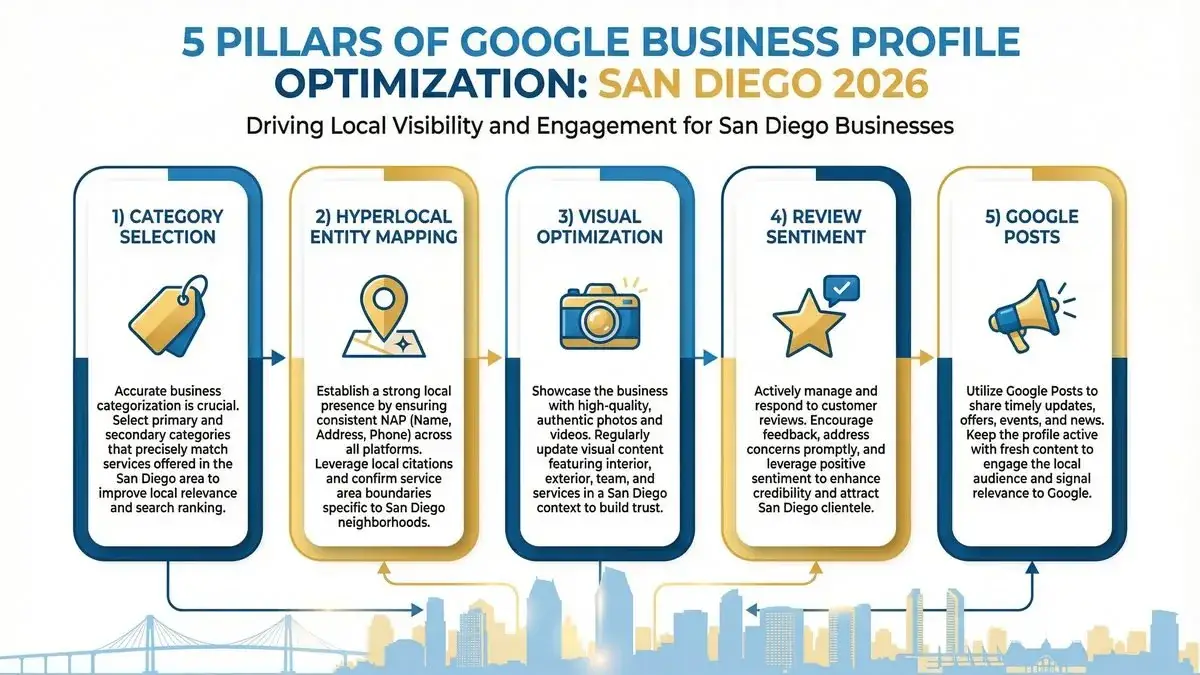
The 5 Pillars of Google Business Profile Optimization for San Diego businesses in 2026.
1. Granular Category and Service Selection
Selecting “Plumber” or “Restaurant” as your primary category is no longer enough. Google offers thousands of specific categories, and you must select the one that most accurately describes your core business. Furthermore, you must utilize secondary categories to cover all your offerings.
Equally important is the Services section. You must list every specific service you provide and write a detailed, keyword-rich description for each one. For example, instead of just listing “SEO,” a marketing agency should list “Google Business Profile optimization San Diego,” “Local SEO Audits,” and “Citation Building.” AI engines scrape these service descriptions to understand exactly what you do.
2. Hyperlocal Entity Mapping
City-level visibility is no longer enough on its own. Locals also search by neighborhood (La Jolla, Gaslamp, North Park), so a strong San Diego presence needs neighborhood detail too. Google’s algorithm has evolved to build sophisticated profiles for neighborhood rankings, incorporating demographic data and cultural characteristics.
Your Google Business Profile strategy in San Diego must reflect this hyperlocal focus. Your business description should mention the specific neighborhoods you serve. Your posts should highlight community involvement. You need to build entity-based relationships with other local businesses and institutions in your specific area.
3. Visual Optimization with Real Photos
Visual search is growing, and both shoppers and AI systems look at your photos to judge the quality of your work. Uploading a few grainy photos of your storefront is insufficient. You need a consistent strategy for uploading high-quality, relevant images.
What matters is that the photos are real and recent. Show your team, your vehicles, your storefront and finished jobs, and add new ones every month so the profile reflects the work you are doing now. Google representatives have said that GPS data stored inside a photo file (EXIF geotags) is not a ranking signal, so skip geo-tagging tools and put that time into better photos, uploaded consistently.
4. Review Sentiment and Response Strategy
AI search engines treat reviews as a filter, not just a ranking signal. Locations recommended by ChatGPT average 4.3 stars, while those on Gemini average 3.9 stars. A rating below that range makes an AI recommendation less likely.
Generating positive reviews is only half the battle. How you respond to them is equally critical. You must respond to every single review, positive or negative, promptly and professionally. Your responses can mention the service and the neighborhood when it reads naturally. For example: “Thank you for the 5-star review! We are glad we could help your North Park business get found on Google Maps.” AI engines read these responses to gauge your engagement and confirm your service areas.
5. Consistent Content via Google Posts
Your Google Business Profile is not a “set it and forget it” directory listing; it is a dynamic micro-blogging platform. Google Posts allow you to share updates, offers, events, and educational content directly on the search results page.
Regularly publishing Google Posts signals to the algorithm that your business is active and engaged. These posts should be highly relevant to your target audience and include strong calls to action. In 2026, maintaining a steady cadence of high-quality Google Posts is essential for keeping your profile fresh and authoritative in the eyes of AI search engines.
How AI Evaluates Your Business Entity
To understand Google Business Profile optimization in San Diego in 2026, you must understand the concept of the “Entity.” To Google and AI search engines, your business is an entity, a unique concept defined by its relationships to other concepts (like your location, your services, your founder, and your reviews).
Schema Markup connects your website to your Google Business Profile, building a trusted Knowledge Graph entity that AI search engines recognize and recommend.
The Importance of Data Consistency
AI engines compile information from across the entire internet to verify your entity. They look at your Google Business Profile, your website, your Yelp listing, your Facebook page, your Clutch profile, and local news mentions. If there is any discrepancy (your hours differ between Yelp and Google, or your address is formatted differently on your website), the AI’s confidence in your entity drops significantly.
This is why NAP (Name, Address, Phone number) consistency remains a foundational element of local SEO. But in 2026, it goes beyond NAP. The story you tell must be consistent across all platforms. If your Google Business Profile emphasizes “emergency plumbing” but your website focuses entirely on “bathroom remodeling,” that disconnect creates a trust issue for the AI.
Schema Markup: The Language of AI
The most direct way to communicate your entity data to AI search engines is through Schema Markup (specifically, LocalBusiness schema). Schema is code added to your website that tells search engines exactly who you are, where you are located, what services you offer, and which social profiles belong to you.
Without proper Schema Markup, AI engines have to guess how your various online profiles connect. With Schema, you explicitly define those connections, building a robust Knowledge Graph entity. This is why ensuring your local SEO services include proper schema configuration is a non-negotiable step for any San Diego business serious about Google Business Profile optimization.
The Cost of Ignoring GBP Optimization in San Diego
The digital landscape in San Diego is fiercely competitive. In a market this crowded, visibility is everything. The cost of ignoring Google Business Profile optimization in San Diego is no longer just a few lost clicks; it is total irrelevance in the AI search era.
When a potential customer asks ChatGPT, “Who is the best local marketing agency in San Diego?” the AI will only recommend businesses that have flawless profiles, strong sentiment, and consistent entity data. If your profile is lacking, your competitor will get the recommendation, and you will never even know you lost the lead.
Frequently Asked Questions About Google Business Profile Optimization in San Diego
How long does it take to see results from GBP optimization?
Most San Diego businesses see measurable improvements in Google Maps visibility within 30 to 60 days of implementing a comprehensive Google Business Profile optimization strategy. AI search visibility typically takes 60 to 90 days as AI engines re-index and update their entity databases.
Can I optimize my GBP without a physical storefront?
Yes. Service-area businesses (SABs), such as plumbers, landscapers, and marketing agencies, can optimize their Google Business Profile by defining their service areas instead of displaying a physical address. The key is to be precise about the neighborhoods and ZIP codes you serve in San Diego.
What is the single most important factor for GBP ranking in 2026?
Review sentiment and response rate. AI search engines use reviews as a primary trust filter. A business with 50 reviews averaging 4.5 stars and a 100% response rate will usually beat a competitor with 200 reviews averaging 3.8 stars and no responses, as long as its categories and business details are accurate.
Partner with UR Local Marketing for Expert GBP Optimization
Navigating Generative Engine Optimization and Google Business Profile optimization in San Diego in 2026 requires expertise and constant vigilance. At UR Local Marketing, led by founder Ahmed M Al Janahy, who has built for the web since 2008, we specialize in future-proofing San Diego businesses. We do not just optimize for today’s algorithm; we build robust digital entities that dominate tomorrow’s search landscape.
If you are ready to stop losing customers to your competitors and start dominating the Google Local Pack and AI recommendations, it is time to invest in professional Google Business Profile optimization. View our local SEO pricing and contact UR Local Marketing today to secure your digital storefront and drive real, measurable revenue.
References:
[2] Forbes: The Future Of Local SEO In 2026 (opens in new tab)