AI search visibility is the share of AI-generated answers that mention or cite your brand when buyers ask ChatGPT, Gemini, Perplexity, or Google’s AI Overviews about your market. In 2026 that share is measurable, and the data shows it is already redistributing demand in San Diego. Google now attaches AI Overviews to roughly half of informational queries in the US, and independent click studies report organic CTR losses of 30 percent or more on those results. Buyers still need painters, locksmiths, restaurants, and repair shops. The question is which brands the machines name first.
This guide breaks down what the 2026 AI search data actually shows: how often AI Overviews appear, what zero-click behavior is doing to traffic, which industries get cited most, and how to measure your own AI search visibility before you spend a dollar fixing it.
- What 2026 Data Shows: AI Overviews and Zero-Click Search
- Which Industries and Sources Get Cited in AI Answers
- How to Measure Your AI Search Visibility
- 5 Proven Moves to Improve AI Search Visibility
- How UR Local Marketing Tracks AI Visibility for Clients
- AI Search Visibility FAQ for San Diego Brands
What 2026 Data Shows: AI Overviews and Zero-Click Search
Start with scale. When Google launched AI Overviews in May 2024, they appeared on roughly 15 percent of US queries. By early 2026, multiple SERP tracking datasets put that figure near or above 50 percent of informational searches, with health, finance, and how-to topics seeing the heaviest coverage. This is not an experiment anymore. It is the default layout for half the questions your customers ask.
Click behavior moved with it. SparkToro and Datos research showed that close to 60 percent of Google searches already ended without a click before AI Overviews scaled. The AI Overviews traffic effect compounds that: Ahrefs’ analysis of 300,000 keywords found the top organic result loses about 34.5 percent of its expected clicks when an AI Overview sits above it. Stack those numbers and the conclusion is plain. Ranking number one no longer guarantees the visit. Being the answer does.
Assistant traffic is the other side of the ledger. ChatGPT passed 800 million weekly users in late 2025, and referrals from chatgpt.com and perplexity.ai now show up in GA4 for most business sites we audit. The volume is still small, often under 2 percent of sessions, but the intent is unusually high. A visitor arriving from an AI answer already heard your name recommended, and they convert closer to referral rates than to cold organic. Every major dataset tracking generative search trends points the same direction.
Which Industries and Sources Get Cited in AI Answers
Citation studies across 2025 and 2026 agree on the pattern. For broad informational queries, AI Overviews and chat assistants lean on Reddit, YouTube, Wikipedia, and established publishers. For commercial and local queries, the sourcing shifts hard toward Google Business Profile data, review platforms like Yelp, and the business’s own service pages.
Industry coverage is uneven, which is good news for local operators. Healthcare, software, finance, and education see heavy AI answer coverage. Home services, restaurants, legal, and emergency trades see lighter but fast-growing coverage. When someone asks an assistant for a painter in La Mesa or a locksmith in North Park, the engines still depend on local entity data because they have nothing better. Brands with complete profiles, consistent name-address-phone data, and steady reviews are the ones that get named.
That is the core 2026 finding: AI engines do not invent authority. They aggregate it. The assistants cite businesses that already look like the obvious answer across Google, maps, reviews, and the open web.
How to Measure Your AI Search Visibility
You cannot manage what you do not measure, and most San Diego brands have never run a single AI visibility check. Here is the four-part measurement stack we use.
- Prompt sampling. Ask ChatGPT, Gemini, and Perplexity 20 to 30 buyer-style questions each month, such as “best phone repair shop in El Cajon,” and log every brand mention and cited source.
- Search Console deltas. Watch queries where impressions hold steady but CTR drops. That gap usually marks new AI Overview coverage on terms you rank for.
- GA4 referral segmentation. Build a channel group for chatgpt.com, perplexity.ai, copilot.microsoft.com, and gemini.google.com, then track sessions and conversions separately.
- Citation share. Track how often your domain appears as a cited source versus competitors across the same prompt set, month over month.
We run this exact stack on our own site. Our AI search optimization program in San Diego holds an average position of 3.9 across the 2026 AI visibility query set we track, and the prompts that cite that page are the same ones that mention our clients. The method works because it treats answers, not just links, as the unit of measurement.

5 Proven Moves to Improve AI Search Visibility
Once you have a baseline, the levers are concrete. These five moves produce the most citation gains in our client work, in roughly this order.
- Clean up your entity. Identical business name, address, phone, and categories across Google Business Profile, Yelp, Apple Maps, and your site footer. Conflicting data makes assistants skip you for a competitor they can verify.
- Ship LocalBusiness schema. Mark up your name, geo coordinates, hours, services, and reviews following Google’s LocalBusiness structured data documentation. Machines cite what they can parse.
- Answer questions in plain text. One question per H2 or H3 with a direct 40 to 60 word answer underneath. That format is what gets quoted verbatim in AI answers.
- Earn third-party mentions. Reviews, local press, supplier directories, and neighborhood groups. Assistants weight what others say about you far more than what you say about yourself.
- Open the door for AI crawlers. Allow GPTBot, ClaudeBot, and PerplexityBot in robots.txt and publish an llms.txt file so engines find your key pages fast.
Sequencing matters as much as the tactics, and most failed AI visibility projects we inherit did the right things in the wrong order. If you want an experienced second opinion before committing budget, here is why SERP consultants in San Diego earn their fee in exactly this situation.
How UR Local Marketing Tracks AI Visibility for Clients
We added AI answer tracking to every local SEO campaign because the data demanded it. Each month clients receive prompt-level reports: which assistants mention them, which sources get cited for their money queries, and how AI referral sessions convert against organic and paid.

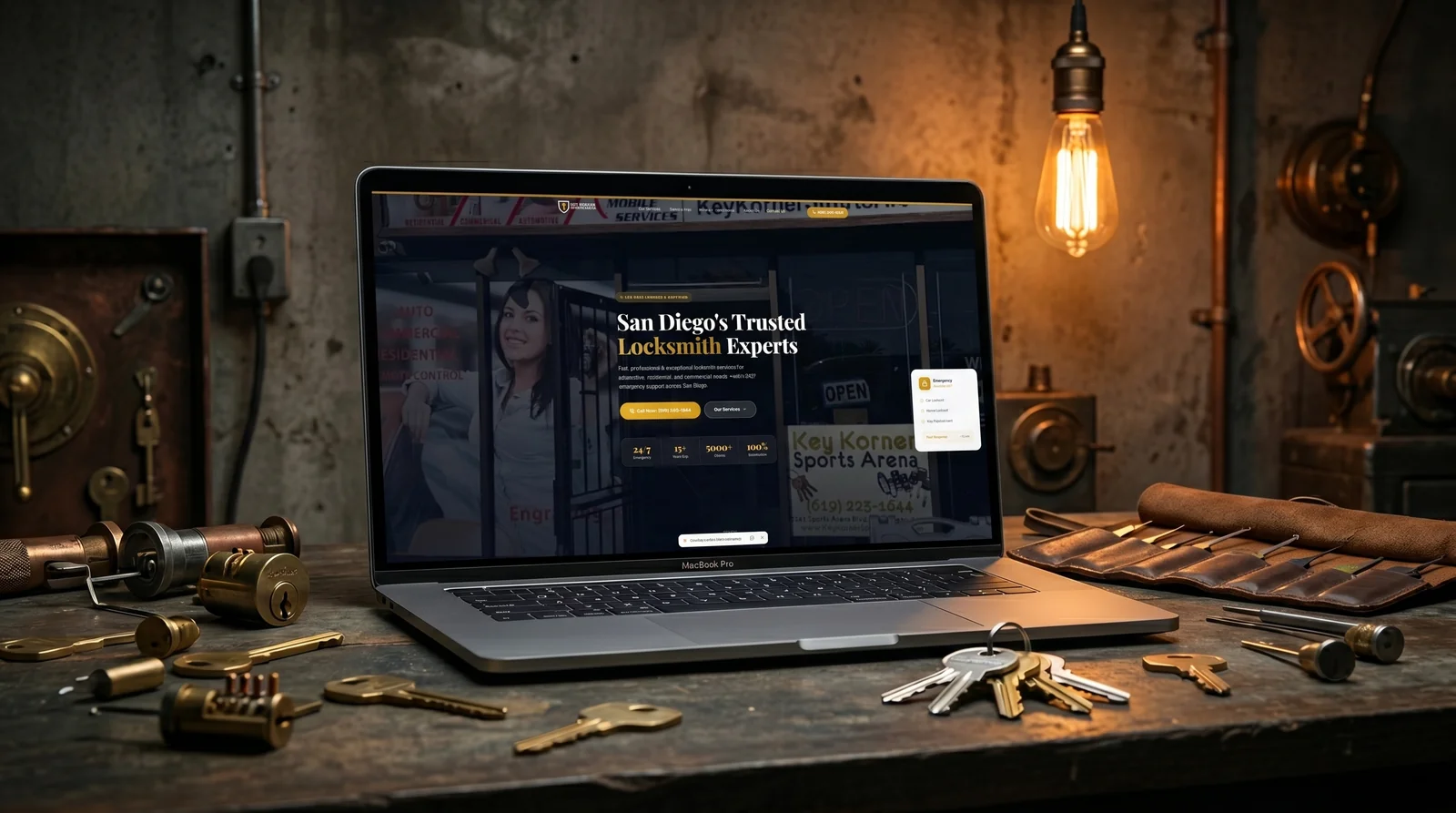
The pattern across our portfolio is consistent. A-K Tech in El Cajon pairs a 95+ PageSpeed site with a tight Google Business Profile and gained 150 percent more calls; it is now the name assistants return for East County phone repair queries. Mal Al Sham grew impressions 400 percent and online orders 250 percent after we rebuilt its entity data. Key Korner locksmith covers 40+ San Diego neighborhoods with a 5.0 rating, which is exactly the third-party proof AI engines reward. Fast sites, clean entities, real reviews. The same inputs that win the Map Pack win the machine answer.
AI Search Visibility FAQ for San Diego Brands
What is AI search visibility?
AI search visibility is how often your brand is mentioned, recommended, or cited when AI systems like ChatGPT, Gemini, Perplexity, and Google AI Overviews answer questions in your market. It is measured through prompt sampling, citation share against competitors, and AI referral traffic in analytics. Treat it like a rank tracker for answers instead of links, and benchmark it monthly.
How do I check my brand visibility in ChatGPT?
Ask ChatGPT 20 to 30 questions a real buyer would ask, such as “best painter in San Diego” or “who repairs iPhones in El Cajon.” Log every business it names and every source it cites, then repeat monthly with the same prompts so you can see movement. Tools can automate this, but manual sampling is free and surprisingly revealing.
Do AI Overviews really cut website traffic?
Yes, for informational queries. Ahrefs measured roughly a 34.5 percent click loss for the top organic result when an AI Overview appears. But transactional and local queries still send clicks and calls, and AI referral visitors convert well. The traffic is not disappearing evenly. It is consolidating onto the small set of brands the answers actually cite.
Does local SEO still matter for AI search in 2026?
More than ever. AI engines build local answers from Google Business Profile data, reviews, citations, and your website content. Every local SEO fundamental now does double duty: it ranks you in the Map Pack and it feeds the exact data AI assistants use to decide which businesses to recommend. Weak local signals mean invisible in both places at once.
How long does it take to improve AI search visibility?
Expect first movement in 60 to 90 days. Structured data, profile cleanup, and crawler access get re-ingested within weeks, while citation share against entrenched competitors builds over one to two quarters. Brands starting from zero measurement usually see the fastest gains, because the obvious fixes have never been made and each one compounds the next.
Want to know what the machines say about your business right now? UR Local Marketing runs a free local visibility audit covering AI mentions, Map Pack position, and your biggest AI search visibility gaps, with findings delivered in 48 hours. Reach our team through 24/7 support or call 888-252-0251, Monday through Friday, 9am to 6pm Pacific.